Difference between revisions of "Template talk:Server Side Software Architecture"
IVSWikiBlue (talk | contribs) |
IVSWikiBlue (talk | contribs) |
||
| Line 1: | Line 1: | ||
| − | {{ | + | {{Section | title = <h1>Server Side Software Architecture</h1> | content = |
| − | |||
| − | <h1>Server Side Software Architecture</h1> | ||
Our server-side software is built on a standard <b>LEMP stack</b> consisting of: | Our server-side software is built on a standard <b>LEMP stack</b> consisting of: | ||
*<strong>Linux</strong> | *<strong>Linux</strong> | ||
| Line 13: | Line 11: | ||
{{hr}} | {{hr}} | ||
| − | + | <center><h2>Core Application Components</h2></center> | |
| Line 32: | Line 30: | ||
*Handles video streaming to client PCs | *Handles video streaming to client PCs | ||
*Responsible for recording, storage, and clip creation | *Responsible for recording, storage, and clip creation | ||
| − | |||
| Line 38: | Line 35: | ||
{{hr}} | {{hr}} | ||
| − | + | <center><h2>Logical Server Architecture</h2></center> | |
| + | |||
| + | |||
The application is divided into two main server roles: | The application is divided into two main server roles: | ||
| Line 55: | Line 54: | ||
*Video stream distribution to clients | *Video stream distribution to clients | ||
*Recording management and clip generation | *Recording management and clip generation | ||
| − | |||
| Line 61: | Line 59: | ||
{{hr}} | {{hr}} | ||
| − | + | <center><h2>Deployment Models</h2></center> | |
| + | |||
{{Float | content = {{img - resize | file = Network Architecture-One Server.webp | width = 300px}} }} | {{Float | content = {{img - resize | file = Network Architecture-One Server.webp | width = 300px}} }} | ||
| − | + | <h3>Single Server</h3> | |
The entire server-side software stack can be deployed on a single [[Servers | physical]] or [[VM - Main Page | VM]]. This configuration is suitable for smaller installations and environments with lower camera counts. | The entire server-side software stack can be deployed on a single [[Servers | physical]] or [[VM - Main Page | VM]]. This configuration is suitable for smaller installations and environments with lower camera counts. | ||
| − | |||
{{hr - 2}} | {{hr - 2}} | ||
{{Float | content = {{img - resize | file = Network Architecture-Multi Server.webp | width = 300px}} }} | {{Float | content = {{img - resize | file = Network Architecture-Multi Server.webp | width = 300px}} }} | ||
| − | + | <h3>Multi-Server</h3> | |
For larger deployments—<em>such as those <b>exceeding 50 cameras</b> or spanning multiple departments</em>—the system supports a distributed architecture using multiple Media Servers. | For larger deployments—<em>such as those <b>exceeding 50 cameras</b> or spanning multiple departments</em>—the system supports a distributed architecture using multiple Media Servers. | ||
| Line 82: | Line 80: | ||
{{Aside - Helpful | content = This architecture provides flexibility, scalability, and efficient handling of high video workloads.}} | {{Aside - Helpful | content = This architecture provides flexibility, scalability, and efficient handling of high video workloads.}} | ||
| − | |||
{{Top of Page}} | {{Top of Page}} | ||
}} | }} | ||
Latest revision as of 11:47, 16 February 2026
Contents
Server Side Software Architecture
Our server-side software is built on a standard LEMP stack consisting of:
- Linux
✎
The application is designed to run on the latest Ubuntu Linux LTS (Server Edition).
- Nginx
- MySQL
- PHP
Core Application Components
Web Server
- Serves the PHP-based application and user interface
- Powered by the Nginx web server
Database
- Stores all unique, customer-specific configuration and application data
- Implemented using MariaDB
Media Server
- Manages communication with cameras
- Handles video streaming to client PCs
- Responsible for recording, storage, and clip creation
Logical Server Architecture
The application is divided into two main server roles:
Application Server:
The Application Server hosts the core application logic and includes:
- PHP web pages served via Nginx
- MariaDB services
- Node.js messaging and control service
Media Server: The Media Server is responsible for all video-related operations, including:
- Camera communication
- Video stream distribution to clients
- Recording management and clip generation
Deployment Models
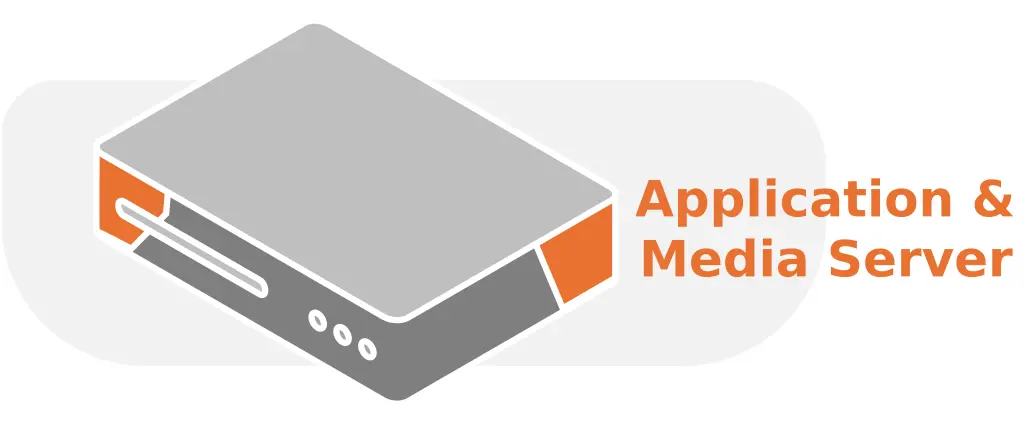
Single Server
The entire server-side software stack can be deployed on a single physical or VM. This configuration is suitable for smaller installations and environments with lower camera counts.
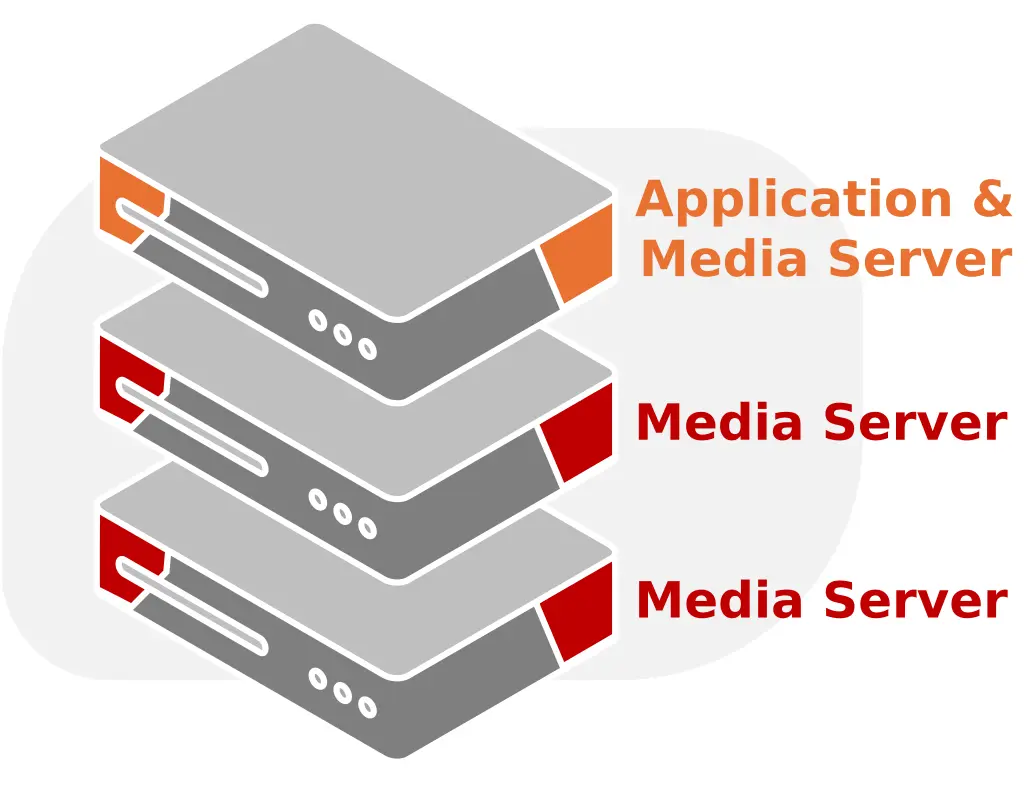
Multi-Server
For larger deployments—such as those exceeding 50 cameras or spanning multiple departments—the system supports a distributed architecture using multiple Media Servers.
In this model:
- One Application Server hosts the core application services
- One or more dedicated Media Servers handle video processing and storage
- Media Servers can be added incrementally to scale performance and capacity
🕮
This architecture provides flexibility, scalability, and efficient handling of high video workloads.
